
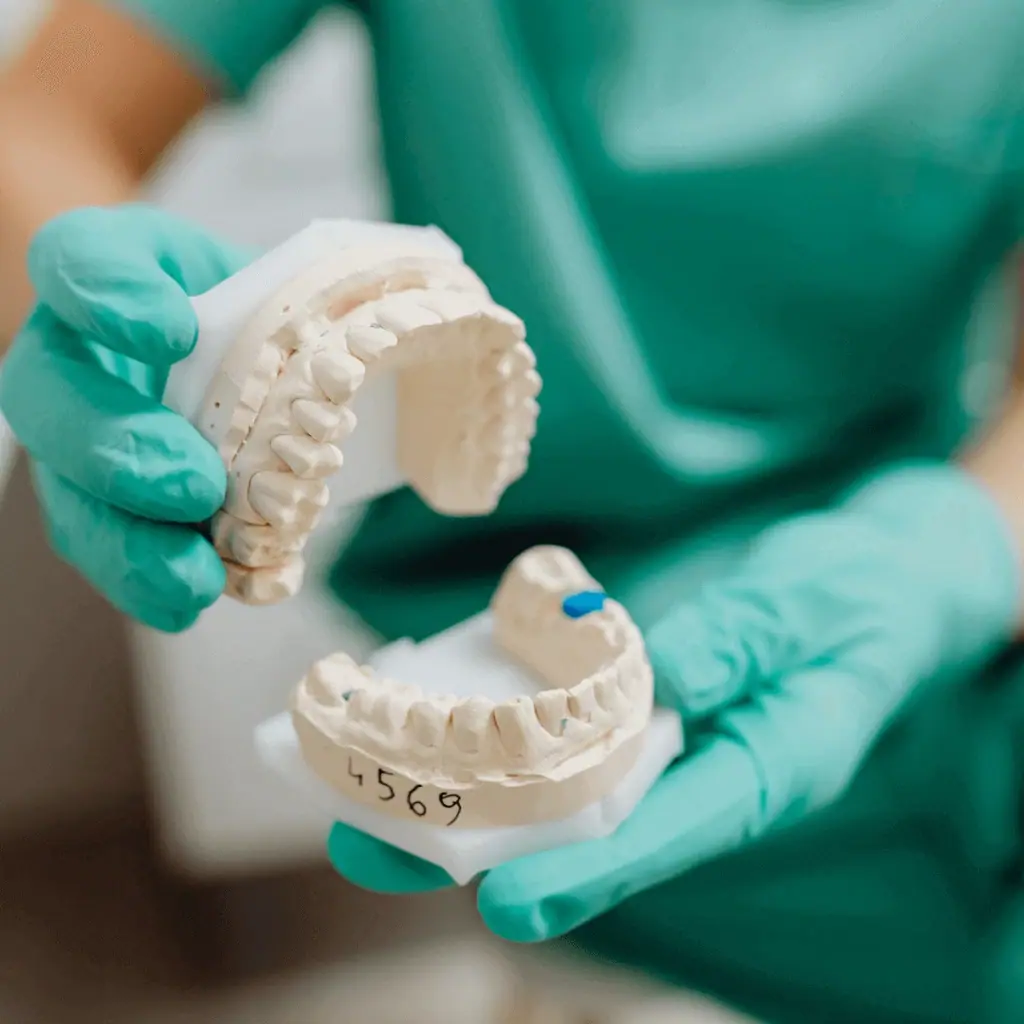
Both close the gap with a fixed tooth that looks natural, and both are good treatments. This article is about choosing between them. For how a bridge is made and the types we offer, see our dental bridges page. For the implant steps, see dental implants and what to expect from an implant, week by week.

What decides between a bridge and an implant?
Four things decide most cases: the health of the teeth on either side of the gap, the bone under the gap, your general health, and how soon you want the gap closed. Cost, your bite and the length of the gap matter too. We start with an exam and regular X-rays, which show decay, old fillings and crowns, and the roots of the neighboring teeth.
The neighboring teeth often matter most. A regular bridge is held by crowns on those teeth, and shaping a tooth for a crown cannot be undone (Cleveland Clinic). A bonded bridge needs less shaping, but it suits only some gaps. If the neighboring teeth are healthy and untouched, that is a strong reason to consider an implant. If they already have large fillings or old crowns, they may need crowns anyway, and then a bridge does both jobs at once.
When is a 3D scan needed?
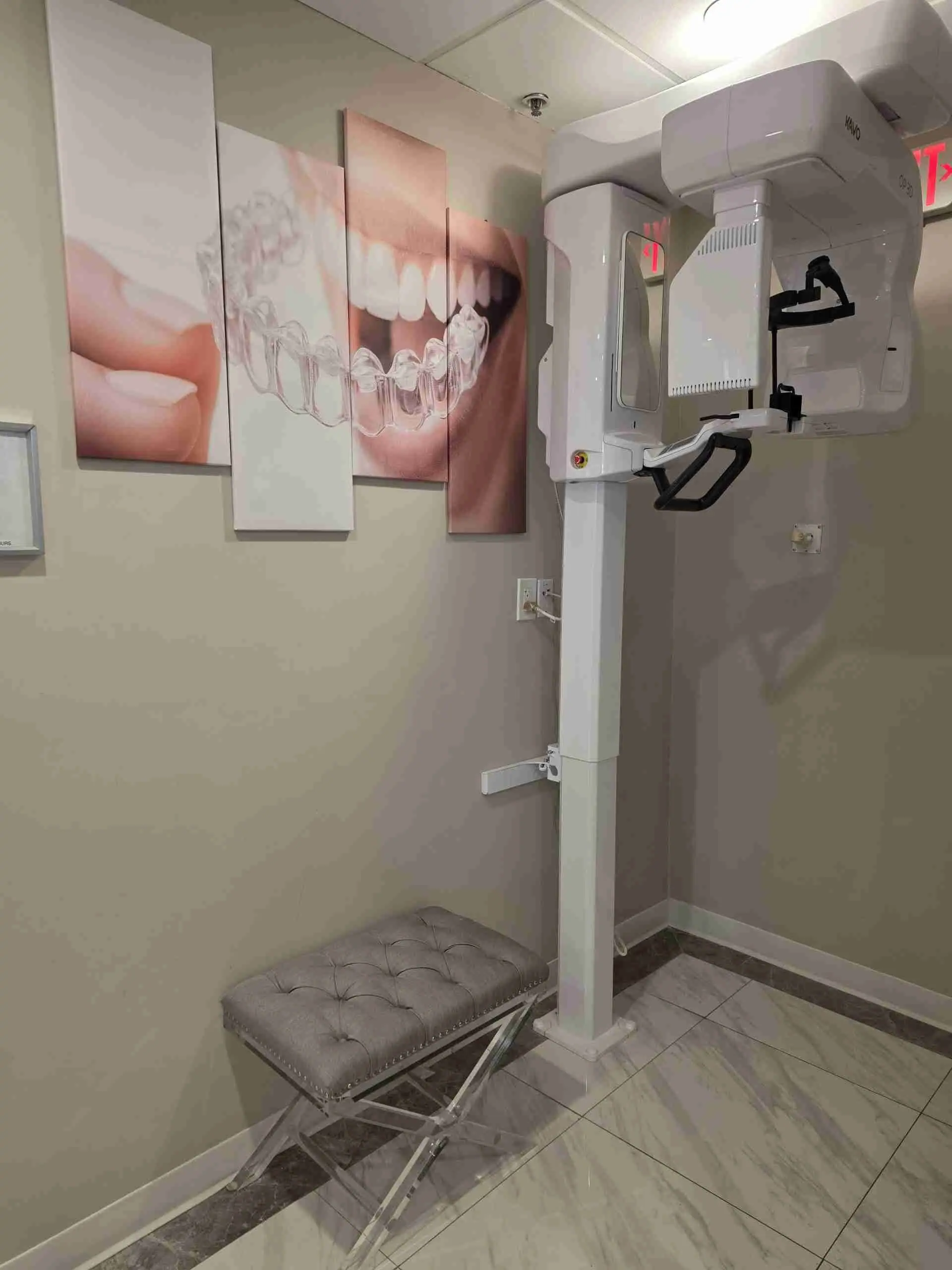
Not for every patient. The American Dental Association advises dentists to order a cone beam CT scan only when it is expected to improve care or safety, not as a routine step (ADA Council on Scientific Affairs). Regular X-rays are often enough to start the conversation about a bridge or an implant.
We use our in-office 3D scanner when the X-rays cannot show what we need. If an implant is being planned, the American Academy of Oral and Maxillofacial Radiology recommends cross-sectional imaging of the site, and a 3D scan is the usual way to get it (AAOMR). It shows how much bone there is and where the nerve and sinus sit. It uses more radiation than a regular X-ray, which is why we take it only when it will help plan your care.

When is a bridge a good choice?
When the teeth beside the gap already need crowns, when the bone under the gap has thinned and you would rather avoid a bone graft (which sometimes means an extra procedure), or when your health makes surgery riskier, such as diabetes that is not well controlled or certain bone or immune medicines. Smoking also raises the risks of implant surgery. Many people with well-managed health conditions can still have implants (Cleveland Clinic). Gum disease needs treating first with either option, because it can also harm the teeth that hold a bridge.
A bridge is also usually quicker: often two visits over about two to four weeks while the lab makes the bridge, against several months for an implant. If a tooth has to come out first, healing can add a few months to either. Lab schedules, healing and your own situation can change either timeline. Replacing a worn-out bridge is another common case: the supporting teeth already have crowns, so a new bridge can be the natural repair, as long as those teeth are still sound underneath.
When is an implant a good choice?
When the teeth beside the gap are healthy, an implant replaces the one tooth without involving its neighbors. It also gives the bone a root to support, which helps it hold its shape. Most bone loss happens in the first months after a tooth is lost, and under a bridge the bone can keep thinning slowly after that.
When three or more teeth in a row are missing, an implant-supported bridge is often considered, because a long bridge needs strong support from the teeth at each end (Cleveland Clinic).
If you are weighing the two now, book a consult and we will look at your teeth and bone together before you decide anything.
How do bridges and implants compare over time?
Both last for many years with good care, and repairs are common with both. In one large review of fixed bridges, about 89 in 100 were still in place after 10 years, and about 3 in 10 had needed a repair or had some other problem along the way (Tan and colleagues, 2004). In another review, about 89 in 100 crowns on implants were still in place after 10 years, the implant posts themselves did a little better, and repairs such as a loose screw or chipped porcelain were common (Jung and colleagues, 2012; Howe and colleagues, 2019). These studies looked at different patients and measured different things, so they do not rank one option above the other. Your dentist can explain what to expect for your mouth.
Each has its weak point. A bridge depends on the teeth that hold it, so decay or gum disease on those teeth can put the whole bridge at risk (ADA, MouthHealthy). That is why cleaning under it every day, with a floss threader or a small brush, matters (Cleveland Clinic). An implant cannot get a cavity, but the gum and bone around it can become inflamed. In one review, about 4 in 10 people with implants had gum inflammation around an implant, and about 1 in 5 had inflammation with bone loss (Derks and Tomasi, 2015). A history of gum disease and poor cleaning raise the risk, so an implant needs the same daily care and regular checkups as your own teeth (2017 World Workshop).
What about cost and insurance?
A bridge usually costs less up front (Cleveland Clinic). For a single missing tooth, a review of cost studies from 2000 to 2010 found an implant was often good value over the long run compared with a three-tooth bridge, though the studies varied, and your own costs depend on your teeth and your insurance (Vogel and colleagues, 2013). We give you the cost of each option before you decide. We accept Aetna, Cigna, Delta Dental, MetLife and UnitedHealthcare, and offer payment plans through Cherry and CareCredit.
Questions patients ask before choosing
Is an implant always better than a bridge?
No. An implant is often a good long-term choice when the teeth beside the gap are healthy, but a bridge may be the better fit when those teeth need crowns anyway, when the bone is thin, or when surgery is riskier for you.
Can I start with a bridge and switch to an implant later?
Often, yes. The bridge would be removed, and the teeth that held it will still need their own crowns. The bone under the gap can thin over time, so a graft may be needed first. A 3D scan at that point shows what is possible.
Does either one hurt?
You are numbed for both, so you should feel pressure but not pain; tell us if you feel anything sharp. After a bridge, some sensitivity to cold for a week or two is common; call us if it gets worse, if it hurts to bite, if the bridge feels loose, or if your gums are sore or bleed. After implant surgery, most people have a few days of soreness and swelling. Everyone's experience is a little different.
What happens if I leave the gap?
Over time, the teeth beside it can tip or drift and the opposite tooth can move toward the space, which can change your bite. How much and how fast varies from person to person, so we check the gap at your visits. Replacing the tooth sooner usually keeps more options open.
If you have a gap and are weighing a bridge against an implant, come in and we will look at the whole picture with you: the teeth beside the gap, the bone and your health. Our office is at 416 N. Bedford Dr. in Beverly Hills, a short drive from Century City and West Hollywood. Request an appointment and we will go through both options with no pressure.